A three-week bathroom in San Diego, built around a custom white oak vanity and a shower rebuilt from the studs out.
White oak in a bathroom
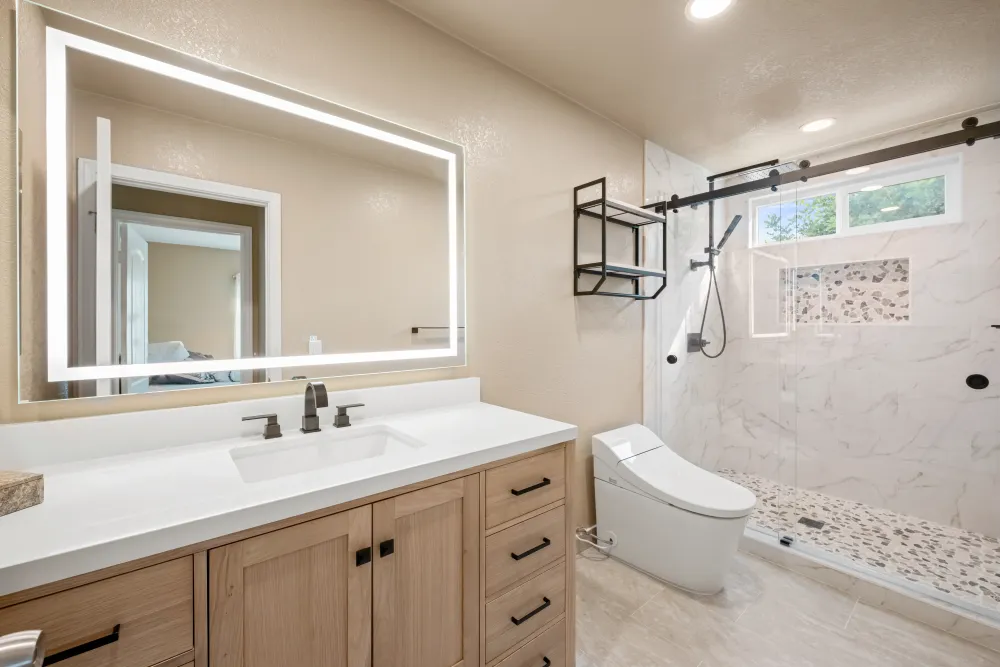
The vanity is custom, in white oak. Wood in a bathroom is a fair question to ask about, and the answer is in how it is built and finished rather than in the species.
White oak is closed-grain and dimensionally stable, which is why it holds up in rooms that swing between dry and steamy several times a day. What matters as much is that the piece is finished on every face, including the underside and the back, so moisture cannot get in through the surfaces nobody sees.
Against a fully tiled room, wood does something tile cannot: it puts one warm, non-repeating surface in a space that is otherwise hard and uniform. In a small bathroom that single element is usually what keeps the room from reading clinical.
The lighted mirror
The mirror is lit from within rather than by a fixture above it.
This is an electrical decision made early. The box has to be located behind where the mirror will hang, at the right height, before the wall is closed and tiled. Get it wrong by a few inches and the options afterwards are a visible cord or opening a finished wall.
The reason to do it is light quality. A fixture mounted above a mirror lights the top of a face and leaves the underside in shadow — which is precisely wrong for the two things people do at a bathroom mirror. Light coming from the mirror's own perimeter arrives from the front and evenly.
The shower
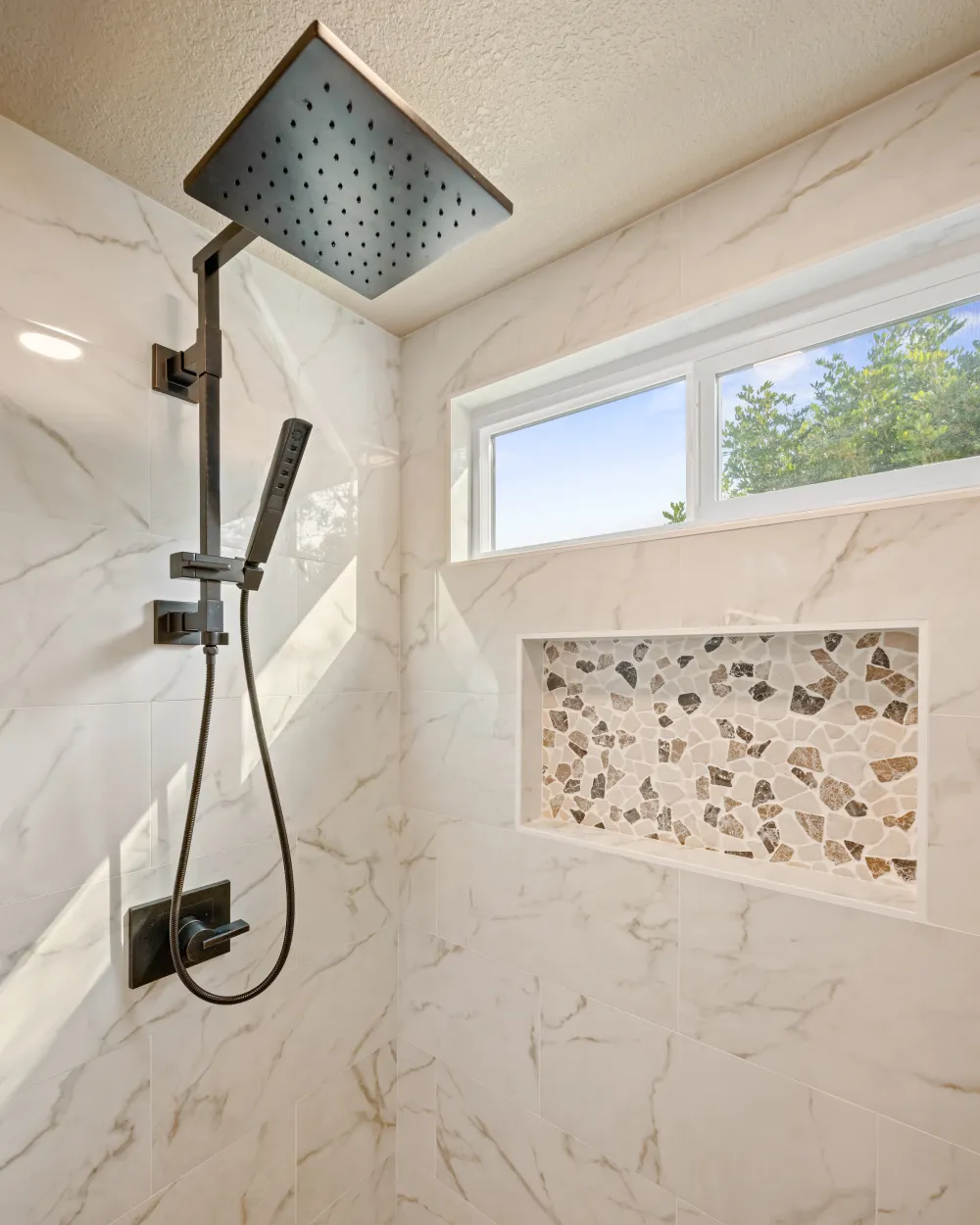
Rebuilt in place, out to the studs. New waterproofing, new pan, new tile. Nothing moved, which is what kept this to three weeks — but nothing was left in place either.
Tile flooring
New tile throughout the room. Worth noting that bathroom floor tile should be chosen for slip resistance when wet, not only for how it looks dry — a large-format polished tile in a small bathroom is a decision people tend to regret in year one.
The result
A compact San Diego bathroom with one piece of real cabinetry in it, finished in three weeks.